Land and lot clearing in Marietta, GA
Underbrush, volunteer pines, fence lines and full build pads — cleared selectively, so the trees worth keeping are still standing at the end.
Call (770) 802-1864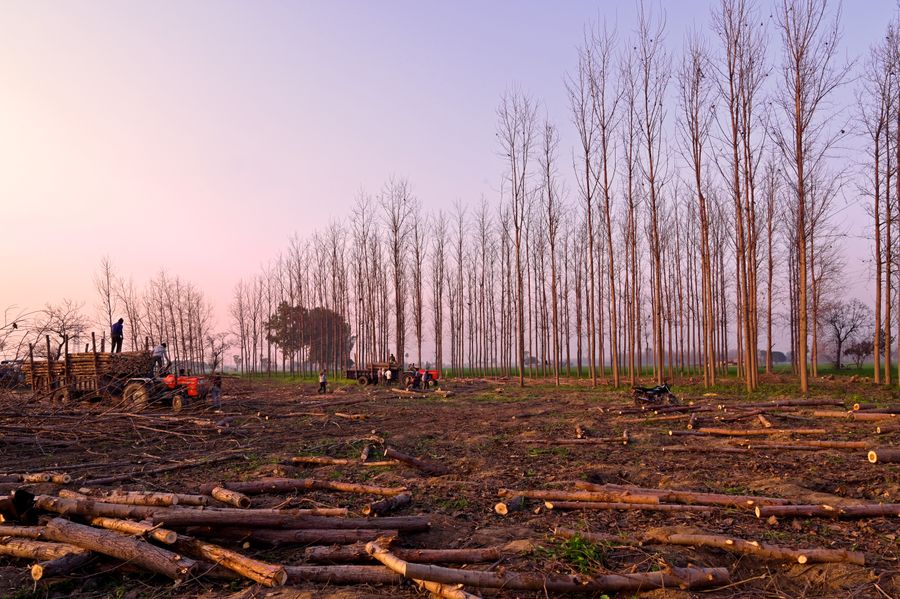
Clearing land in Cobb County is rarely all-or-nothing. The lots worth building on usually have a few mature hardwoods that took eighty years to grow and would cost a fortune to replace with anything comparable. The skill is deciding what stays before anything comes down — and then protecting it properly while the machines work.
What we clear
- Underbrush and understory. Privet, kudzu, greenbrier, sweetgum and cherry saplings, honeysuckle. Reclaiming a back acre that has been left alone for a decade is our most common clearing job.
- Selective thinning. Taking out volunteer pines and poor-form stems while keeping the specimen oaks, hickories and poplars. This is what turns a thicket into usable woodland.
- Fence lines and property boundaries. Cleared to a workable width so a fence crew can install straight and you can maintain it.
- Build pads and driveways. Full clearing for new construction, additions, detached garages, shops and pools.
- Pasture and food plot reclamation. Common on the larger West Cobb and Cherokee County parcels.
- Firebreaks and defensible space around structures on wooded property.
Two methods, and when each makes sense
Forestry mulching uses a mulching head to grind standing vegetation into chips in place. Nothing gets hauled, the chip layer stays as erosion control and mulch, and it is fast and clean with minimal soil disturbance. It is excellent for underbrush and stems up to roughly 8 to 10 inches. Its limit is that stumps and root systems stay in the ground, so it is not the method for a build pad.
Conventional clearing — cut, remove, grub stumps, haul off — is what you need where foundations, slabs or utilities are going in. It is more disruptive and produces material that has to leave the site, and it costs more. Many jobs use both: mulch the understory, conventionally clear the footprint.
What clearing costs around here
Light clearing of mostly underbrush commonly runs around $2,500 per acre. Dense, heavily wooded acreage with large stems can exceed $6,000 per acre, and adding stump grinding and full haul-off pushes a project higher again. The real cost drivers are stem density and size, slope and access for equipment, how much has to be hauled off site versus mulched in place, and whether stumps are grubbed. Nobody can price this accurately from a map — it needs a walk of the property.
Permits and erosion control are the part people skip. Land disturbance in the City of Marietta requires a Land Disturbance Activity application, and tree removal permits are not issued until Development Services has reviewed and approved the plans. Unincorporated Cobb County enforces its own tree protection ordinance through the Community Development Agency, with site density requirements tied to land disturbance permits — commonly expressed as a minimum number of tree units retained per acre. Georgia's erosion and sedimentation rules also apply to disturbed ground, which typically means silt fence and stabilization. Clearing first and asking later can mean stop-work orders, fines and mandatory replanting. We will tell you what your project needs and can handle the applications.
Deciding what stays
Before anything starts we walk the property with you and mark it out. What is generally worth protecting: mature white and red oaks, hickories, healthy tulip poplars, anything with good form that will end up in a visible position, and trees whose removal would trigger replacement requirements. What usually goes: crowded volunteer loblolly, sweetgum, hackberry, storm-damaged and hollow stems, anything within the future footprint, and invasives.
Then the trees that stay get fenced at the critical root zone, and the access routes and material stockpiles are set outside those fences. This is the step that gets skipped on most sites, and it is why so many "preserved" trees are dead five years after a build. Roots do not recover from being driven over — soil compaction under a mature oak is effectively permanent.
Green waste and what leaves the site
Every clearing job produces green waste, and where it goes is a real line on the quote. Mulched in place it stays as a chip layer and costs you nothing to dispose of. Hauled off, you are paying for trucking and tipping. On vegetation clearing jobs with a lot of small stems, mulching is almost always the cheaper answer; on a build pad it has to leave. We tell you which applies before you sign anything.
Erosion, which matters on Georgia clay
Bare red clay on a slope after a summer thunderstorm moves in a hurry, and it moves into whatever is downhill of you. Where we clear on grade we recommend silt fencing at the low side, prompt stabilization with seed and straw or the mulch layer itself, and keeping equipment traffic off saturated ground. Cheap to do during the job, expensive to fix afterward.
Getting a real number
Send us the parcel address and roughly what you want to end up with — buildable pad, cleared understory with the big trees kept, open pasture. We will walk it, mark it, and put a written scope and price in front of you. Related work often quoted at the same time: individual tree removal for anything oversized, and stump grinding where the ground has to be usable.
Get a written price for this job
Call (770) 802-1864 and talk it through with someone who has actually done this work. The site visit and the written estimate are free either way.
Call for a free on-site estimate
One call, no obligation, and a written price before anything starts. The line is answered 24 hours a day — including storm nights and holidays.
(770) 802-1864Tap to call · Open 24/7
Have this ready and we can quote faster
- Roughly how tall the tree is, and the species if you know it.
- What it is closest to — house, driveway, fence, power line.
- Anything that has changed: a new lean, a crack, deadwood appearing.
- Your address or nearest cross street in Marietta or Cobb County.
If a tree is on a structure, blocking your way out, or touching anything electrical, call straight away rather than waiting for business hours.
Land Clearing — common questions
With a mulching head on light underbrush, an acre or more a day is realistic. Dense growth with substantial stems, or conventional clearing with stump grubbing and haul-off, is much slower — sometimes several days per acre. We give you a scope and a timeline after walking the site.
Yes. A large share of our clearing work is a quarter to half acre — reclaiming an overgrown back yard, opening a view, clearing for a shop or pool, or cleaning up a wooded strip between houses.
With forestry mulching it stays on site as a chip layer, which doubles as erosion control. With conventional clearing, brush is chipped and hauled, and merchantable timber may be sold off on larger jobs, which can offset part of the cost. We tell you up front which applies.
Very likely, once you are past minor landscaping. Land disturbance triggers permitting in both the City of Marietta and unincorporated Cobb County, and tree ordinances set retention requirements. Confirm with the relevant office before work starts — Marietta Planning & Zoning is 770-794-5671 — or let us handle the application.
Yes, and this needs to be flagged before we start. Mark the tank, field lines and wellhead. Heavy equipment over a drain field can crush lines and compact the soil the field depends on, which is a far more expensive problem than the clearing.
It can, on any slope, and Georgia clay is unforgiving about it. That is why we recommend silt fence at the downhill edge and prompt stabilization as part of the scope rather than an afterthought. On mulched jobs the chip layer does a lot of this work for you.
Other tree work in Marietta
Get that tree handled this week
Free on-site estimate, written price before anything starts, and a crew that cleans up before it leaves.